
Open cell, closed cell, and when to use each
Spray Foam Insulation in Durham, NC
One application that stops air leaks and insulates, sprayed where it does the most good in a humid Piedmont house.
- Free on-site look at the attic and crawl space
- Written quote with foam type, thickness and R-value by area
- Moisture, wood and vent problems flagged before we cover anything
Foam That Seals as It Insulates
Spray Foam Insulation is a liquid that expands on contact into a foam that fills gaps, sticks to wood and masonry, and cures in place. Unlike batts or loose fill, it blocks air movement as well as heat flow, so it handles both of the problems that make Durham houses uncomfortable: hot, humid air sneaking in during summer and warm air leaking out in winter. We spray two kinds of foam, and choosing between them is most of the skill.
Open-cell foam
Open-cell foam is light and soft, with cells that are not fully closed. It expands far beyond its sprayed thickness, which makes it good at filling irregular framing, and it damps sound. HomeGuide's 2026 guide lists it at about R-3.5 to R-3.7 per inch and $1.50 to $3.50 per square foot installed. Because it lets some water vapor through, it works best above grade: on the underside of a roof deck to bring the attic inside the conditioned space, in bonus room walls and kneewalls, and in interior walls where noise matters.
Closed-cell foam
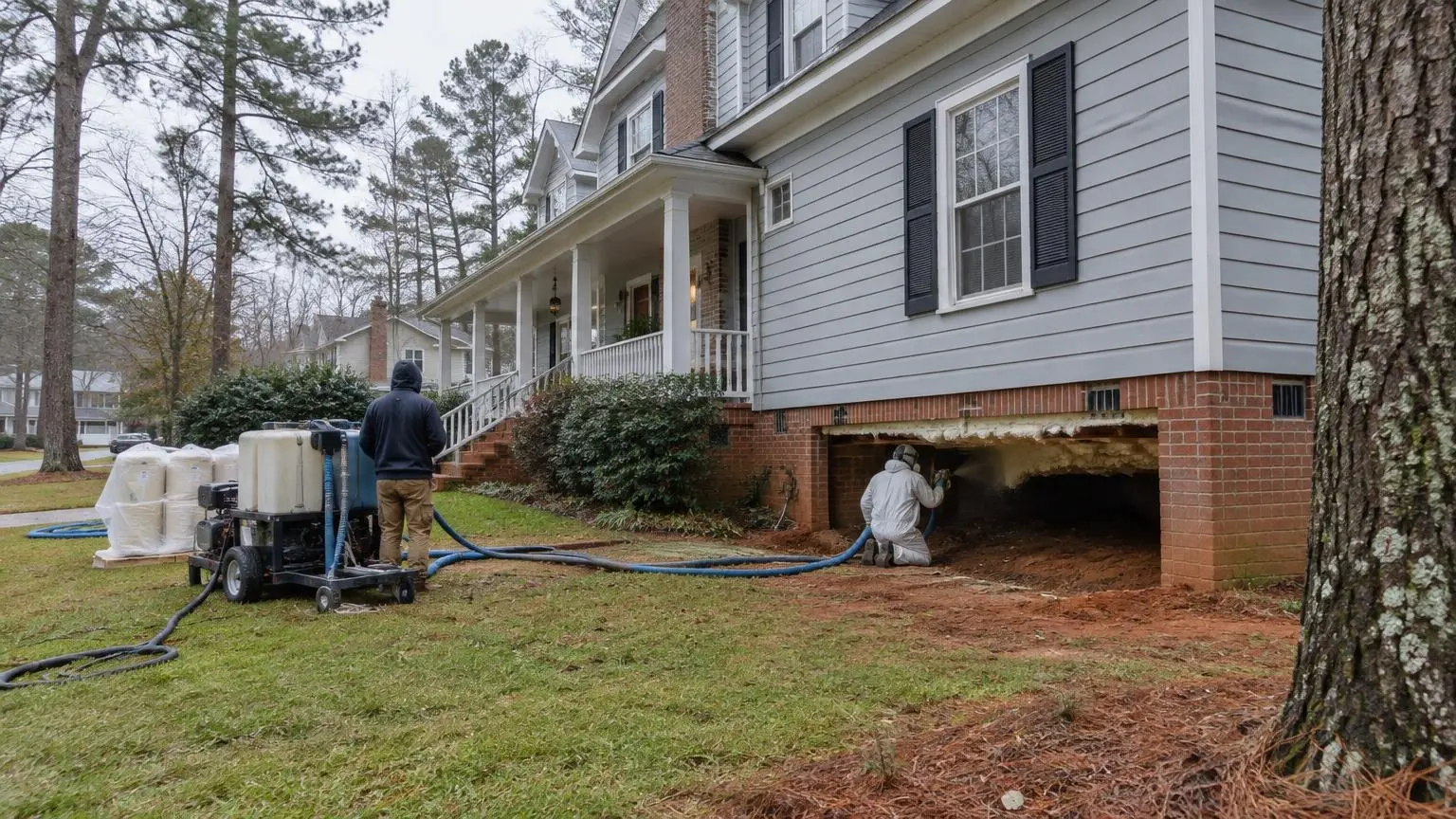
Closed-cell foam is dense and hard. It runs about R-5 to R-7 per inch and $3.00 to $5.00 per square foot in the same guide. At typical thickness it slows vapor, adds stiffness and does not soak up water. That makes it our usual choice where moisture is the enemy: crawl space foundation walls, rim joists, and slab edges, plus metal buildings and garage doors where condensation forms. It costs more per inch, so we use it where those properties matter.
Where foam makes sense in a Triangle house
- Under the roof deck. If the air handler and ducts live in the attic, which is common in Triangle houses built since the 1970s, spraying the roof deck pulls them inside the insulated space instead of leaving them in a 130-degree attic.
- Crawl space walls and rim joists. Closed-cell foam on the walls of a sealed crawl space keeps the floor above warmer in winter and stops humid air from creeping in at the band joist.
- Bonus rooms and kneewalls. The odd shapes of a room over the garage are hard to insulate with batts and easy to fill with foam.
- Older walls opened up. When plaster or drywall is off in an older Durham house, open cavities can be sprayed before the walls close again.
Where it does not
On a wide, flat attic floor with easy access, foam is rarely the cheapest way to reach R-38 or more. Sealing the bypasses with foam and caulk and then blowing loose fill to depth usually costs less. We will tell you when that is the better plan.
Before we spray
Foam goes onto clean, dry surfaces only. We check for roof leaks, wet framing, active termite damage and wiring that needs attention first. Exposed foam in living spaces and some attics needs a thermal or ignition barrier under building code, and we explain what your space needs before you approve the work. You will need to stay out of the house while foam is sprayed and for a period afterward; HomeGuide's guidance is at least 24 hours. Get a free estimate
What This Covers
The foam work we do most often around Durham.
Roof deck (unvented attic)
Open-cell or closed-cell foam on the underside of the roof so the attic, ducts and air handler sit inside the insulated shell.
Crawl space walls and rim joists
Closed-cell foam on foundation walls and band joists, usually paired with a ground liner.
Bonus room walls and floors
Foam in kneewalls, sloped ceilings and the floor over the garage, sealed against garage air.
Open walls during remodels
Spraying exposed stud cavities before new drywall goes up.
Garages, shops and outbuildings
Closed-cell foam on walls, ceilings and metal panels to cut heat gain and stop condensation.

Typical Spray Foam Insulation Costs
| Job | Published range (source) |
|---|---|
| Installed spray foam | $1.50 to $5.00 per sq ft (HomeGuide) |
| Open-cell vs closed-cell | $1.50 to $3.50 vs $3.00 to $5.00 per sq ft (HomeGuide) |
| Roughly 1,000 sq ft | $1,500 to $5,000 (HomeGuide); $3,150 to $7,500 in an existing home (Fixr) |
| Existing walls vs new construction | $3.15 to $7.50 vs $2.75 to $6.50 per sq ft (Fixr) |
| Exterior walls, whole house | $4,000 to $10,000 (HomeGuide) |
| Whole-house foam | $8,000 to $20,000 (HomeGuide); $10,000 to $30,000 (Fixr) |
| Common job minimum | $1,000 to $2,000 or more (HomeGuide) |
National numbers from HomeGuide (2026) and Fixr (2025), not Durham quotes. Foam type, thickness, access and prep move the total, and small jobs often hit a minimum. We measure first, and the written estimate we hand you is the price.
How a Foam Job Goes
1. Look
We inspect the space, check for moisture and damage, and note wiring, ducts and vents.
2. Quote
You get foam type, thickness, R-value and price for each area in writing.
3. Prep
We cover floors and belongings, mask what should not get foam and set up ventilation.
4. Spray
Foam goes on in passes to the planned thickness, and we check depth as we go.
5. Clean up and walk through
Trimmings and debris leave with us, and we show you the finished work before you sign off.

Why Choose Us for Spray Foam Insulation
The right foam for each spot
Closed-cell where moisture is a risk, open-cell where it is not, and we explain the choice.
Thickness you can check
The quote lists inches and R-value, and you can measure the result.
Problems found first
Leaks, wet wood and pest damage get flagged before foam covers them.
Spray Foam Insulation Questions
Is spray foam worth it in Durham?
It is worth it where air sealing and moisture control matter: roof decks over attic ductwork, crawl space walls, rim joists and bonus rooms. On an open attic floor, blown-in insulation over sealed bypasses usually gives more R-value per dollar.
Does spray foam cause mold?
Foam does not feed mold, but trapping moisture can cause problems in any assembly. That is why we fix leaks and wet wood first and pick closed-cell foam where vapor is a concern.
How long does spray foam take?
Most single areas, like a crawl space or bonus room, take a day. Larger roof-deck jobs can take two. You will need to stay out of the house during spraying and for at least 24 hours afterward, per HomeGuide.
Who manufactures spray foam insulation?
Several chemical companies make two-part spray foam systems for both open-cell and closed-cell foam. What matters more for you is the product chosen for each space, its listed R-value per inch, and its fire rating where foam is left exposed, and we put that information on the quote.

Spray Foam Insulation Service Areas
- Spray Foam Insulation in Durham, NC
- Spray Foam Insulation in Chapel Hill, NC
- Spray Foam Insulation in Carrboro, NC
- Spray Foam Insulation in Hillsborough, NC
- Spray Foam Insulation in Morrisville, NC
- Spray Foam Insulation in Cary, NC
- Spray Foam Insulation in Apex, NC
- Spray Foam Insulation in Raleigh, NC
- Spray Foam Insulation in Wake Forest, NC
- Spray Foam Insulation in Creedmoor, NC
- Spray Foam Insulation in Butner, NC
- Spray Foam Insulation in Mebane, NC
- Spray Foam Insulation in Pittsboro, NC
- Spray Foam Insulation in Roxboro, NC
- Spray Foam Insulation in Oxford, NC
Get a Spray Foam Insulation Estimate
Tell us which space you want foamed and we will come measure it.