
Depth for less
Blown-In Cellulose & Fiberglass in Durham, NC
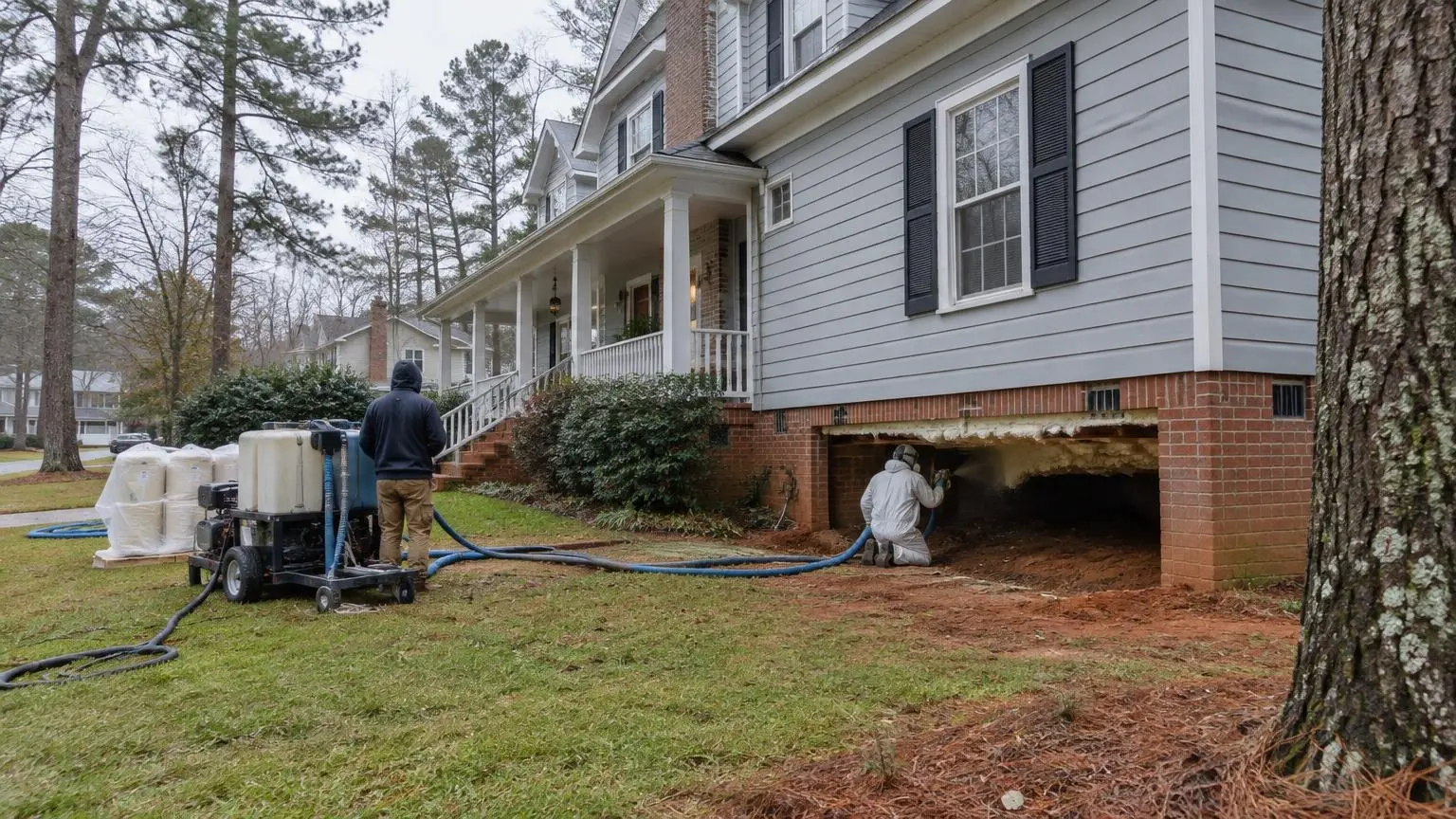
Loose fill blown over a sealed attic floor or dense-packed into walls that were never insulated.
- Free on-site look at the attic and crawl space
- Written quote with foam type, thickness and R-value by area
- Moisture, wood and vent problems flagged before we cover anything
The Workhorse of Attic Insulation
Blown-In Cellulose & Fiberglass is often the most economical way to bring a Durham attic up to code depth. Loose-fill fiberglass or cellulose is blown through a hose and settles into an even blanket that covers joists, wires and odd corners better than batts can. It is our usual choice for wide-open attic floors once the air leaks below are sealed, and for older walls that have no insulation at all.
Cellulose or fiberglass?
Cellulose is made mostly from recycled paper treated with fire retardant. It is dense, fills around obstructions well, and in walls it can be dense-packed tight enough to slow air movement. Loose-fill fiberglass is lighter, does not absorb water as readily and settles less. Both reach the same R-value when blown to the right depth, so the choice usually comes down to the space and your preference. Fixr's guide lists both at similar per-square-foot prices.
Reaching the target depth
North Carolina's 2018 energy code lists R-38 for ceilings in Climate Zone 4A, which covers Durham. ENERGY STAR suggests R-49 to R-60 for retrofits in the same zone. Many attics in older Durham neighborhoods hold a few inches of settled fiberglass or old rock wool. We measure what you have, then blow new fill to the depth that hits the target, and leave depth markers on the attic floor.
Older walls
Houses from Durham's early 1900s building boom were often built with no wall insulation. Where the walls are closed and in good shape, we can drill small holes, from outside under the siding or inside, and dense-pack cellulose into each stud bay. We check for knob-and-tube wiring first, since live knob-and-tube should not be buried in insulation. That is a job for an electrician before we start.
Sealing comes first
Blown insulation does not stop air leaks on its own. Before we blow an attic, we seal the bypasses at plumbing, wiring, chases and top plates, insulate the hatch, and install baffles at the eaves. The air sealing is listed as its own line on the quote. Get a free estimate
What This Covers
Loose fill and dense-pack work in attics and walls.
Attic top-off
New loose fill blown over existing dry insulation to reach the target R-value.
Full attic insulation
Blown to depth after old, damaged insulation is removed.
Dense-pack walls
Cellulose packed into closed stud bays through small drilled holes.
Air sealing beforehand
Bypasses, hatch and top plates sealed before any fill goes down.
Typical Blown-In Insulation Costs
| Job | Published range (source) |
|---|---|
| Blown-in, per sq ft | $1.00 to $2.80 (HomeGuide); $1.65 to $3.80 (Fixr) |
| Attic | $900 to $3,600 (HomeGuide); $1,750 to $5,500 for about 1,500 sq ft (Fixr) |
| Exterior walls | $1,900 to $7,800, or $1.10 to $3.70 per sq ft (HomeGuide); $2,000 to $4,000 (Fixr) |
| Dense-pack cellulose | $1.60 to $4.20 per sq ft (HomeGuide) |
| Fiberglass vs cellulose | $1.65 to $2.60 vs $1.75 to $3.80 per sq ft (Fixr) |
| Typical project | $800 to $3,000 (HomeGuide); $3,000 to $7,000 (Fixr) |
Figures are national ranges from HomeGuide (November 2025) and Fixr (August 2025). Attic size, depth, access, sealing and removal change the cost. We quote after measuring, and our written estimate is what you pay.
How a Blown-In Job Goes
1. Measure
Existing depth and condition, attic area, wiring and ventilation.
2. Seal
Bypasses, hatch and eaves handled first.
3. Blow
Fill blown evenly to the depth on the quote, with markers.
4. Clean up
Hoses out, house cleaned, photos of the finished attic.
Why Choose Us for Blown-In Cellulose & Fiberglass
Sealing is not skipped
Air sealing is a line on the quote, not an afterthought.
Marked depth
Depth markers show the insulation reached the target.
Wiring checked
We look for knob-and-tube before dense-packing older walls.
Blown-In Cellulose & Fiberglass Questions
Is blown-in insulation better than spray foam?
On an open attic floor, blown-in over sealed bypasses usually gives more R-value per dollar. Foam is better for roof decks, crawl space walls and spaces where moisture or tight framing make loose fill a poor fit.
How long does blown-in insulation last?
Dry, undisturbed loose fill keeps working for decades. It loses value when it gets wet, gets packed down by foot traffic or is disturbed by rodents.
Can you blow insulation into my plaster walls?
Often, yes, by drilling small holes and dense-packing cellulose. We check for knob-and-tube wiring and blocking inside the walls first.
Will blown insulation settle?
Some settling happens, more with cellulose. We blow to the settled depth the manufacturer lists for the target R-value.
Blown-In Cellulose & Fiberglass Service Areas
- Spray Foam Insulation in Durham, NC
- Spray Foam Insulation in Chapel Hill, NC
- Spray Foam Insulation in Carrboro, NC
- Spray Foam Insulation in Hillsborough, NC
- Spray Foam Insulation in Morrisville, NC
- Spray Foam Insulation in Cary, NC
- Spray Foam Insulation in Apex, NC
- Spray Foam Insulation in Raleigh, NC
- Spray Foam Insulation in Wake Forest, NC
- Spray Foam Insulation in Creedmoor, NC
- Spray Foam Insulation in Butner, NC
- Spray Foam Insulation in Mebane, NC
- Spray Foam Insulation in Pittsboro, NC
- Spray Foam Insulation in Roxboro, NC
- Spray Foam Insulation in Oxford, NC
Get a Blown-In Cellulose & Fiberglass Estimate
Ask us to measure your attic and we will quote the depth it needs.