
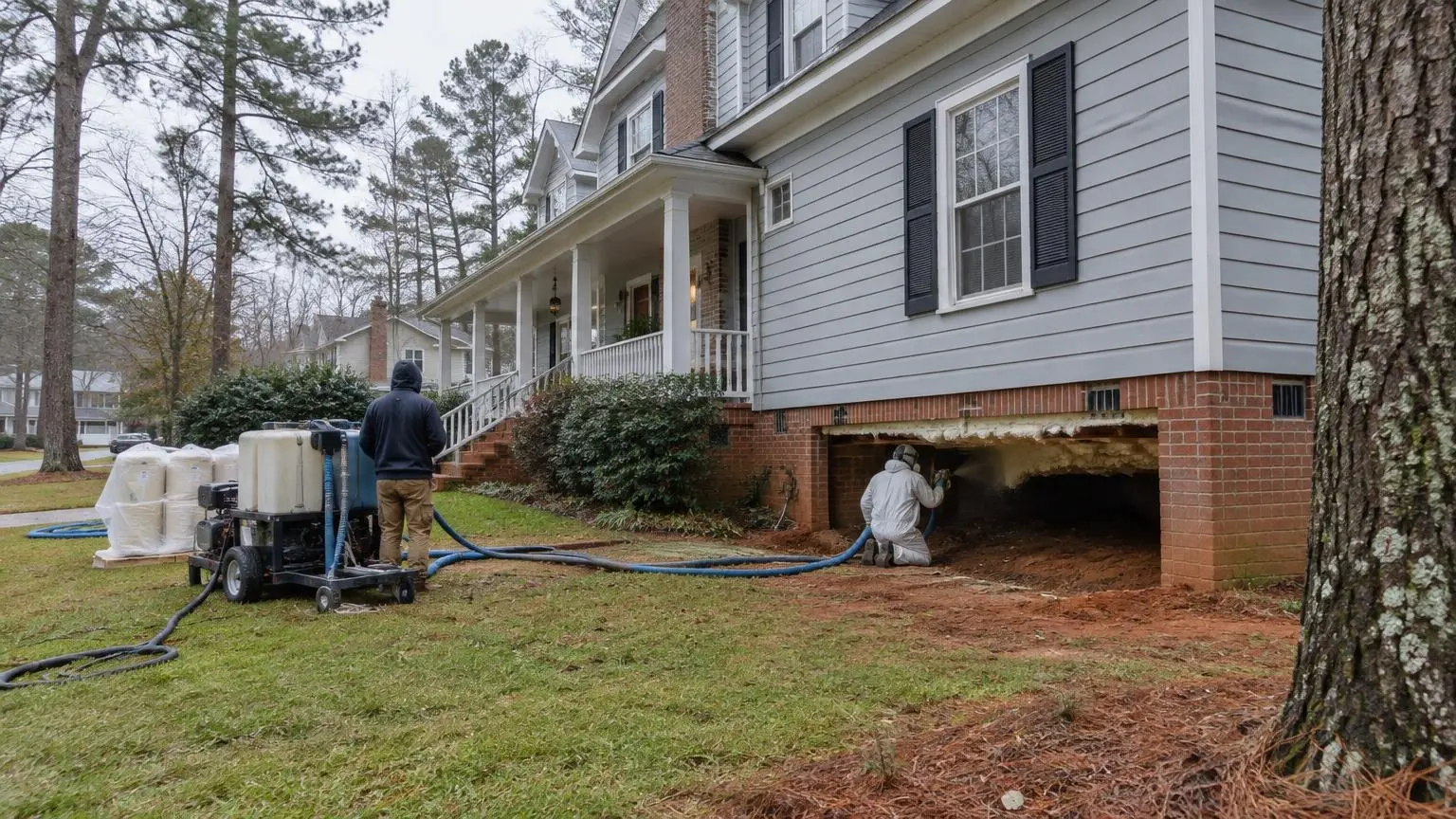
From Trinity Park porches to south Durham cul-de-sacs
Spray Foam Insulation in Durham, NC
Bull City houses span 130 years of building, and each era leaks in its own places.
- Free on-site look at the attic and crawl space
- Written quote with foam type, thickness and R-value by area
- Moisture, wood and vent problems flagged before we cover anything
One City, Many Kinds of Houses
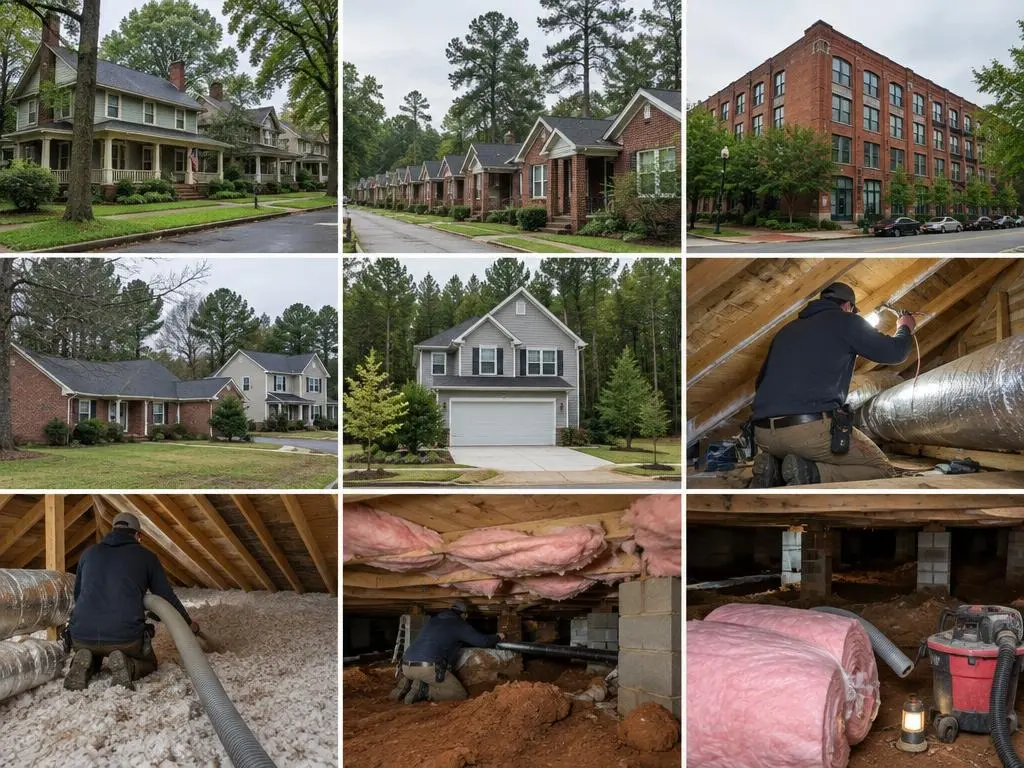
Spray Foam Insulation in Durham covers a wider range of houses than almost anywhere in the Triangle. Wikipedia's history of the city notes that much of Durham's early residential and commercial building dates from about 1890 to 1930, the decades when Bull Durham tobacco, American Tobacco and then the textile mills drove growth. Mill villages grew up in what were called East Durham and West Durham before the city annexed them. Then, starting in the 1970s and 1980s, subdivisions spread south toward Research Triangle Park, and since 1990 most new housing has followed the I-40 corridor in southern Durham County.
Pre-war houses near downtown
Bungalows, foursquares and mill houses from the early 1900s were built before anyone insulated walls. Many sit on brick piers or low brick foundations with a dirt-floored crawl space underneath, and the attic may hold a few inches of old rock wool or nothing at all. In these houses we usually start with the crawl space and the attic, where the payoff is largest, then talk about walls. Closed walls can often be dense-packed with cellulose; if you are opening plaster during a renovation, open-cell foam can fill the bays before the new drywall goes up. We check for knob-and-tube wiring before covering anything.
South Durham subdivisions
Houses built from the 1970s through the 2000s near RTP, Southpoint and the I-40 corridor typically have fiberglass in the attic, batts under the floor and an air handler in the attic or crawl space. The complaints we hear are a hot upstairs, a bonus room that never cools, and a musty smell in summer. Those trace back to attic bypasses, kneewalls with no backing and crawl space batts that have drooped in humid air.
Summer is the hard season
The airport's 1991-2020 normals list a July daily mean of 80.5F and an average July high of 90.8F, with a dew point near 68F through midsummer. That moisture is why we treat Durham crawl spaces with care: insulating over a damp space without fixing the moisture just hides the problem. Winters still matter, with an average January low of 31.8F, so a well-sealed attic and floor help both ways.
Spray foam insulation cost in Durham
National guides give a starting point: HomeGuide lists installed foam at $1.50 to $5.00 per square foot and a crawl space at roughly $2,000 to $4,000. In Durham the biggest swings come from access. A 1920s crawl space with 18 inches of clearance and brick piers takes longer than a newer one with block walls and room to work, and an attic over a low-pitched ranch is slower than a tall one. We measure first and price what we see.
We give every Durham homeowner a written quote, area by area, after looking at the house. Get a free estimate
What to Know in Durham
- Building eras. Much of Durham's early residential and commercial architecture dates from about 1890 to 1930, and housing developments spread south toward Research Triangle Park in the 1970s and 1980s (Wikipedia).
- Growth corridor. Most of Durham's residential growth since 1990 has been along the I-40 corridor in southern Durham County; the 2022 ACS counted 134,423 housing units in the city.
- Heat and humidity. Raleigh-Durham airport normals (1991-2020): July daily mean 80.5F, average July high 90.8F, July dew point about 67.8F, annual rain about 46 inches.
- Code zone. Durham County is in IECC Climate Zone 4A (OpenEI). ENERGY STAR suggests R-60 for an uninsulated attic in that zone and R-19 under floors.
Durham Questions
Is spray foam a good idea for an old Durham bungalow?
In the right spots. Closed-cell foam on crawl space walls or rim joists and open-cell foam in walls opened during a renovation both work well. For the attic floor, sealing gaps and blowing loose fill is usually cheaper.
My south Durham house smells musty in summer. Is that the crawl space?
Very often. Vented crawl spaces pull in humid air, and wet batts under the floor hold that moisture. We check moisture levels in the wood and the ground cover before suggesting encapsulation or a repair.
Do you work in Durham neighborhoods with historic district rules?
Yes. Insulation work in attics and crawl spaces normally does not change the outside of the house. If exterior changes are involved, such as drilling siding for dense-pack, check with the city first.
How soon can you look at my house?
Call or send the form with your address and the problem, and we will set up a visit and send a written quote afterward.
Spray Foam Insulation Near Durham
- Spray Foam Insulation in Chapel Hill, NC
- Spray Foam Insulation in Carrboro, NC
- Spray Foam Insulation in Hillsborough, NC
- Spray Foam Insulation in Morrisville, NC
- Spray Foam Insulation in Cary, NC
- Spray Foam Insulation in Apex, NC
- Spray Foam Insulation in Raleigh, NC
- Spray Foam Insulation in Wake Forest, NC
- Spray Foam Insulation in Creedmoor, NC
- Spray Foam Insulation in Butner, NC
- Spray Foam Insulation in Mebane, NC
- Spray Foam Insulation in Pittsboro, NC
- Spray Foam Insulation in Roxboro, NC
- Spray Foam Insulation in Oxford, NC