
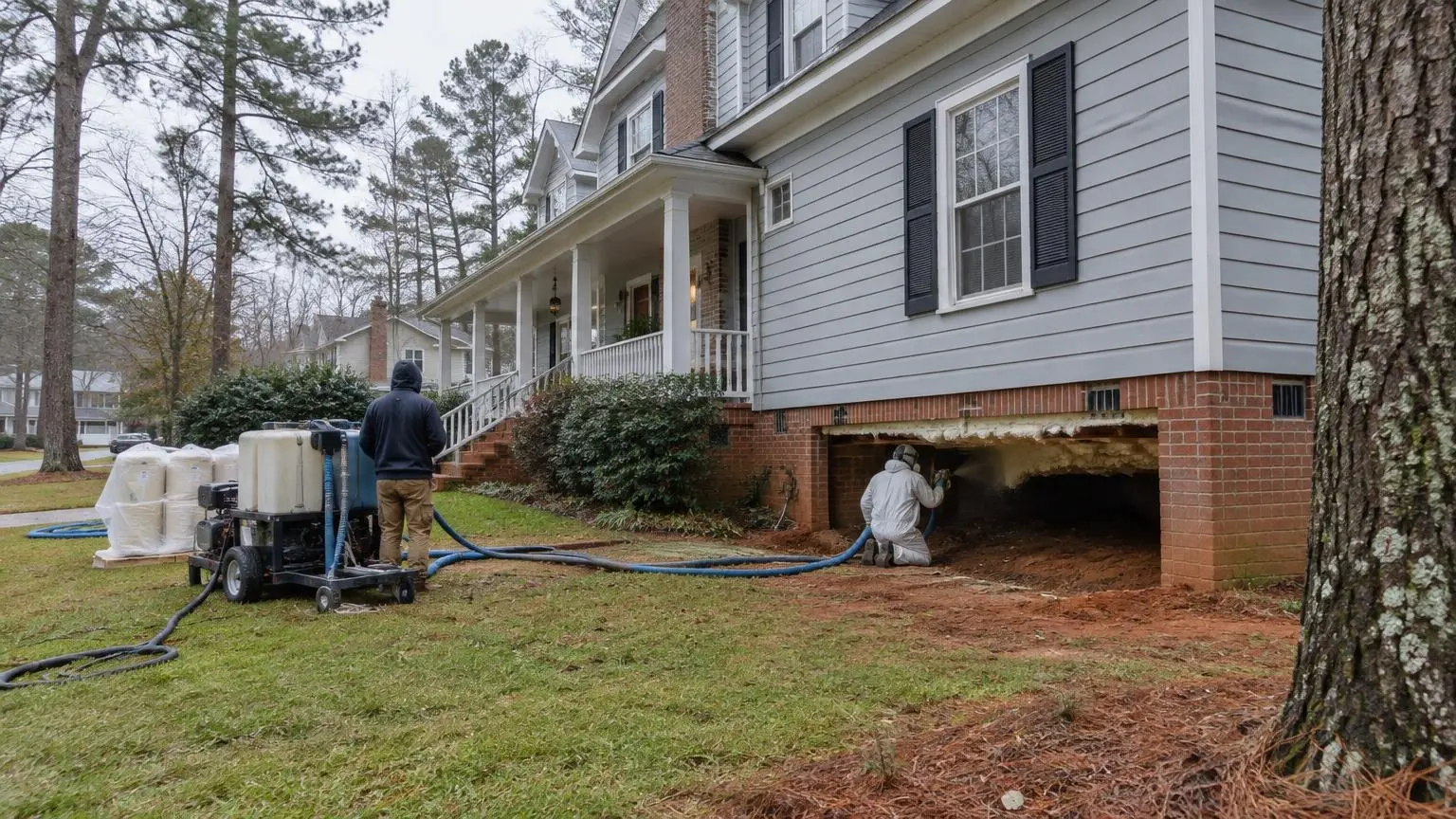
Attics, crawl spaces and bonus rooms across the Triangle
Spray Foam Insulation in Durham, NC
Keep humid summer air out of the house and the heat in during winter: foam where it pays off, blown-in where it does the job for less, all priced in writing.
- Free on-site look at the attic and crawl space
- Written quote with foam type, thickness and R-value by area
- Moisture, wood and vent problems flagged before we cover anything
Built for Humid Summers and Damp Crawl Spaces
Spray foam insulation in Durham has a different job than it does up north. Here the hard season is summer: long stretches of heat, thick humidity, attics that bake and crawl spaces that breathe damp air. We seal and insulate Durham homes with open-cell or closed-cell spray foam where it is the right tool, and with blown-in cellulose or fiberglass where that does the job for less money. Most of our work happens in the two places central North Carolina houses lose the most comfort: the attic and the crawl space.
Durham weather, by the numbers
The 1991-2020 normals for Raleigh-Durham International Airport, published on Wikipedia's Durham page, put the July daily mean at 80.5F and the average July high at 90.8F. The average dew point in July and August sits near 68F, which is what makes a Triangle summer feel heavy. Winters are short but real: the average January low is 31.8F, the record low is -9F, and snowfall averages about 5 inches a year. Rain comes steadily, about 46 inches a year. Put those together and you get a house that runs its air conditioner for months and its heat for a few cold weeks, with moisture pressing in from outside most of the year.
What the code says for Durham County
Durham County, like the rest of the Triangle, falls in IECC Climate Zone 4A, the mixed-humid zone (OpenEI's county list). North Carolina's 2018 Energy Conservation Code, built on the 2015 IECC with state amendments, took effect January 1, 2019, and the Insulation Institute's summary lists R-38 for ceilings (or R-30 continuous). ENERGY STAR's retrofit table goes further for Zone 4A: R-60 for an attic with no insulation, R-49 added on top of 3 to 4 inches already there, and R-19 under floors. For crawl space walls it lists R-10 insulating sheathing or an R-13 batt. Those numbers set the depth or thickness we write on your quote.
Durham houses, old and new
Much of Durham's early commercial and residential building dates from roughly 1890 to 1930, when tobacco and then textiles drove the city's growth. Mill neighborhoods in what were East and West Durham were later annexed into the city. Those older houses tend to have balloon framing, open wall cavities, little or no insulation in the walls, and crawl spaces with dirt floors. Housing developments then spread south toward Research Triangle Park in the 1970s and 1980s, and most of the residential growth since 1990 has run along the I-40 corridor in southern Durham County. Those houses usually have some insulation, but the crawl space batts sag, the attic insulation has settled, and the bonus room over the garage is the hottest room in the house. The 2022 American Community Survey counted 134,423 housing units in the city, and very few of them were built tight.
Closed cell vs open cell
Open-cell foam is soft and spongy. It expands a lot, fills odd-shaped cavities and stops air movement, but it lets some water vapor pass. HomeGuide puts it at about R-3.5 to R-3.7 per inch. Closed-cell foam is dense and rigid at R-5 to R-7 per inch, and at normal thickness it slows vapor and does not soak up water. In Durham we usually reach for closed-cell on crawl space walls and rim joists, where ground moisture and humid air are the problem, and open-cell under roof decks and in bonus room walls and kneewalls, where its sound damping and lower cost help. The right choice depends on the assembly, so the quote explains why we picked each one.
Spray foam insulation contractors: questions to ask
Whether you call us or other spray foam insulation companies and insulation contractors in the Triangle, a few questions separate a careful job from a fast one. Ask what gets air sealed before insulation goes in. Ask which foam goes where, at what thickness, and what R-value that reaches. Ask how the crawl space will be dried out or vented, how ductwork in the attic will be handled, how long you need to stay out of the house after spraying (HomeGuide suggests at least 24 hours), and what happens to old insulation. A good answer is specific and comes in writing. Searching for spray foam insulation near me will turn up plenty of names; the written details are what let you compare them.
Spray foam insulation cost
HomeGuide's 2026 cost guide lists installed spray foam at $1.50 to $5.00 per square foot: about $1.50 to $3.50 for open-cell and $3.00 to $5.00 for closed-cell. For about 1,000 square feet that works out to $1,500 to $5,000, and HomeGuide puts a crawl space at $2,000 to $4,000. Fixr's guide lists $3.15 to $7.50 per square foot for existing walls. Many installers also have a job minimum of roughly $1,000 to $2,000. Those are national figures; your price depends on the space, the access and the prep, and the number on our written estimate is what you pay.
Rebates worth checking
Duke Energy's attic insulation page lists instant rebates for single-family homes that raise attic insulation to at least R-38, from $0.25 to $0.31 per square foot (up to $600 to $800 depending on how little insulation is there now). The rebate requires a free Duke Home Energy Check and work by a Duke-approved contractor, and the page does not say which of its service areas qualify, so check with Duke before you count on it.
We serve Durham and the towns around it, from Chapel Hill and Hillsborough to Cary, Apex, Creedmoor and Roxboro. Get a free estimate
Where We Work
Our base market is the city of Durham and Durham County, including the neighborhoods near Duke, the older streets around downtown, and the subdivisions south toward Research Triangle Park. To the west we work in Chapel Hill, Carrboro and Hillsborough in Orange County, and out to Mebane. To the southeast we cover Morrisville, Cary and Apex, and to the south Pittsboro and the new neighborhoods of northern Chatham County. North of Durham we go to Butner, Creedmoor and Oxford in Granville County, and Roxboro in Person County, plus Wake Forest and Raleigh to the east. Older mill towns, university towns and fast-growing suburbs each have their own insulation problems, and the town pages below explain what we look for in each.
- Spray Foam Insulation in Durham, NC
- Spray Foam Insulation in Chapel Hill, NC
- Spray Foam Insulation in Carrboro, NC
- Spray Foam Insulation in Hillsborough, NC
- Spray Foam Insulation in Morrisville, NC
- Spray Foam Insulation in Cary, NC
- Spray Foam Insulation in Apex, NC
- Spray Foam Insulation in Raleigh, NC
- Spray Foam Insulation in Wake Forest, NC
- Spray Foam Insulation in Creedmoor, NC
- Spray Foam Insulation in Butner, NC
- Spray Foam Insulation in Mebane, NC
- Spray Foam Insulation in Pittsboro, NC
- Spray Foam Insulation in Roxboro, NC
- Spray Foam Insulation in Oxford, NC
What We Do
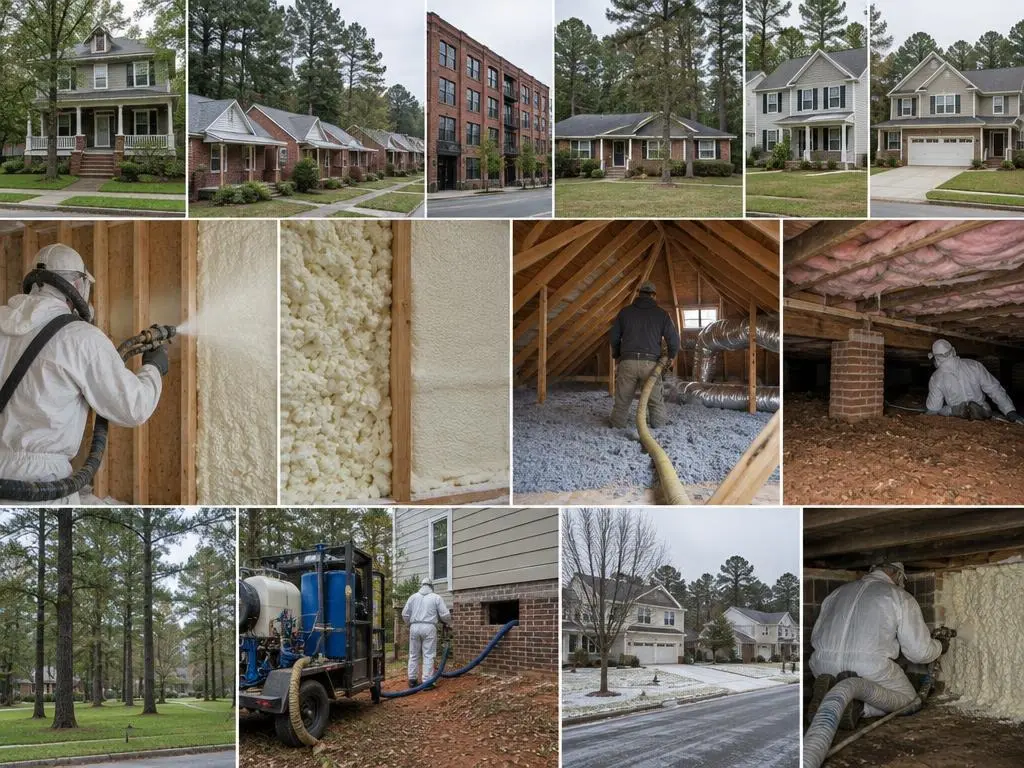
Six kinds of insulation work, matched to each part of the house, from closed-cell foam on crawl space walls to clearing out old attic fill.
Spray Foam Insulation
Open-cell and closed-cell foam that insulates and air seals in one step, chosen part by part for each space in the house.
Learn more →Crawl Space Encapsulation & Insulation
Seal a damp, vented crawl space with a ground liner and wall insulation, or repair the floor insulation the right way.
Learn more →Attic Air Sealing & Insulation
Close the gaps that leak cooled air into a hot attic, then bring insulation up to R-38 or more.
Learn more →Bonus Room & Kneewall Insulation
Fix the room over the garage that is always too hot in summer and too cold in winter.
Learn more →Blown-In Cellulose & Fiberglass
Loose fill blown to depth in attics and dense-packed into closed walls, often the lowest-cost route to R-38 and above.
Learn more →Old Insulation Removal
Clear out wet, moldy, rodent-damaged or flattened insulation so the new work starts clean.
Learn more →Common Questions
What are the downfalls of spray foam insulation?
It costs more per square foot than fiberglass or cellulose, it is hard to remove once cured, and it must be applied correctly to cure and smell right. You also need to stay out of the house for a while after spraying; HomeGuide suggests at least 24 hours. That is why we use foam where its air sealing and moisture resistance matter and blown-in insulation where they do not.
What insulation should be used in North Carolina?
It depends on the part of the house. North Carolina code for the Triangle (Climate Zone 4A) calls for R-38 ceilings, and ENERGY STAR suggests R-49 to R-60 in an attic. Blown cellulose or fiberglass is usually the cheapest way to reach that depth on an open attic floor, while closed-cell foam suits crawl space walls and rim joists, and open-cell foam works well under roof decks and in bonus room walls.
How much does it cost to spray foam?
HomeGuide lists $1.50 to $5.00 per square foot installed, with open-cell at the low end and closed-cell at the high end, or about $1,500 to $5,000 for 1,000 square feet. A crawl space runs about $2,000 to $4,000 in that guide. We give you a written price after measuring.
Closed cell vs open cell: which is better for a Durham house?
Neither is better everywhere. Closed-cell resists moisture and is our usual pick for crawl space walls and rim joists. Open-cell is softer, cheaper per inch of thickness and works well under the roof deck or in walls where it can expand into the cavity.
Should I insulate my crawl space or seal it?
Many Durham crawl spaces pull in humid outside air through foundation vents all summer, and sagging fiberglass under the floor stops working once it gets damp. Sealing the crawl space with a ground liner and insulating the walls is one fix; repairing the floor insulation and vapor barrier is another. We look at drainage, wood moisture and your HVAC setup before recommending either.
Does Duke Energy offer a rebate for attic insulation?
Duke Energy lists an instant attic insulation rebate for single-family homes brought up to at least R-38, ranging from $0.25 to $0.31 per square foot. It requires a Home Energy Check and a contractor on Duke's approved list, so confirm eligibility with Duke before relying on it.
Why Homeowners Call Spray Foam Insulation Durham
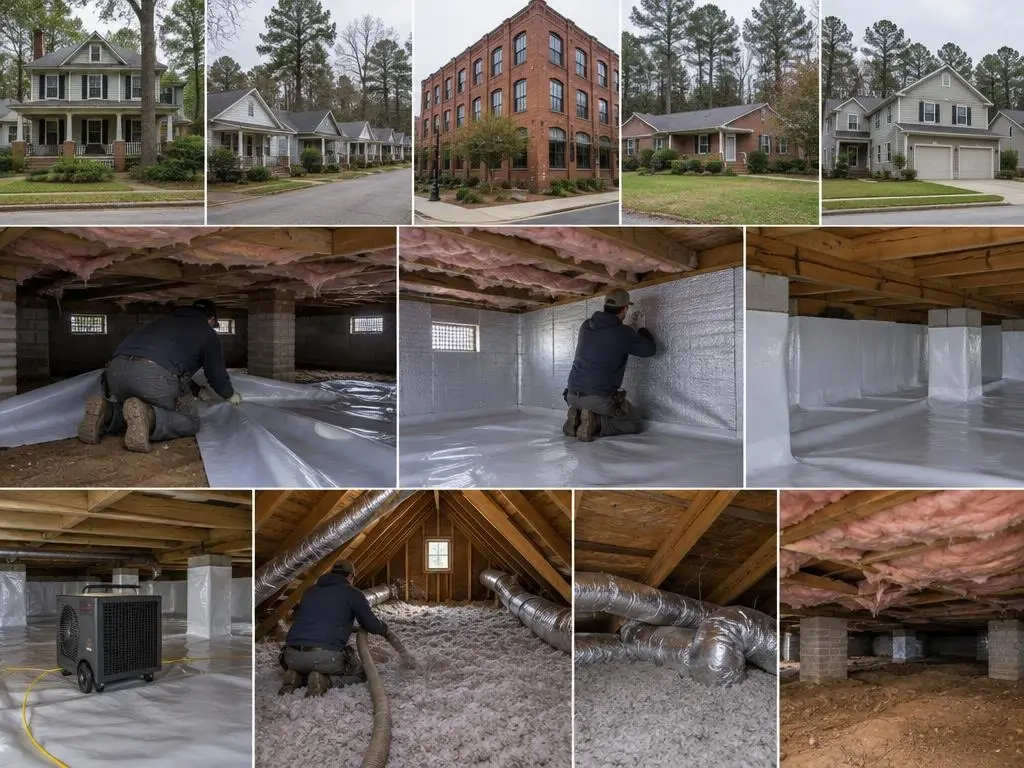
Attic and crawl space on one visit
Most Triangle houses lose comfort at both ends, so we inspect both and tell you which one matters more.
Foam only where it earns its cost
Closed-cell, open-cell, blown cellulose or fiberglass: each area gets the material that fits it, and the quote says why.
Moisture first
Standing water, wet wood, loose vapor barrier and duct condensation get flagged before any insulation goes over them.
Prices in writing
Each space is its own line with material, thickness or depth, target R-value and cost, so you can compare quotes fairly.
Get a Spray Foam Insulation Estimate
We look at the attic and crawl space, then send a written price with the material and R-value for each area.